Welcome to the official British Kung Fu Association web site. We hope you find this website informative and easy to use.

We hope to provide you with information about Kung Fu, the Lau Gar style and classes available in your area.

This web site is endorsed by Grand Master Yau (the keeper of the Lau Gar Style) and the Lau Gar Guardians.


Lau Gar was first established in the UK well over 50 years ago and has become one of the most well known and successful styles in the UK. 

Even though Lau Gar has become famous for it's tournament fighters, many people do not realise it's foundations and strengths are traditional in every way, from empty hand forms, traditional weapons, two person drills, hand and body conditioning. There is also Chi Kung/Qi Gong and meditation to strengthen the body from the inside.

Lau Gar is a traditional sophisticated and fascinating martial art that you can continue to learn for a lifetime.

  • Let's start with an explanation of few terms and expressions. The term 'kung fu' (or 'gung fu') literally means 'achievement through great effort' but is also taken to be the name of a group of Chinese martial arts which typically feature sharp blows and kicks. The term 'kung' means something like achievement or merit, and 'fu' can be translated into man.

    History of Kung Fu
    Many people are under the impression that Kung Fu originated with the Shaolin Temple. It did not. Read on to get the details.
    Although many people believe that the Chinese martial arts originated at the Shaolin Temple there is some evidence to suggest that the Chinese martial arts were well developed before the Shaolin Temple was built. The temple was built in the third century A.D. but there are references to such individuals as the physician Hwa Tuo who was using exercises based on animal movements to improve the physical health of his patients well before that date. Hwa Tuo lived at the time of the Three Kingdom, around A.D. 220-65. Hwa Tuo is said to have created a set of exercises based upon five animals: the tiger, bear, monkey, stork and dear. The reason this is significant is that there is even today a strong relationship between animal movement and the Chinese martial arts. 


    In fact the Shaolin temple did become a centre of development for the martial arts and remained so for more than a thousand years before it was dissolved by the Ching Dynasty in the Eighteenth Century. As a side note the Shaolin Temple is situated at the foot of the 'Songshan' mountain in Dengfeng County, Honan Province. It should also be said that there have been many Shaolin Temples built all around China. Whether these were set up as competitors to the temple at Songshan or represented an extension of the original Shaolin Temple is not known.

    Da Mo (Bodhidharma) 
    In the year 527 AD, a monk known as Da Mo (Bodhidharma) arrived at the Shaolin Temple. Dat Mo is belived to have been an Indian monk who was probably born in Kanchipuram near Madras. Da Mo travelled to the city of Kuang, now known as Canton, where he was granted an audience with the Emperor at the time, Wu Ti of the Liang Dynasty. The Emperor had instructed local Buddhist monks to translate Buddhist texts from Sanskrit to Chinese with the intention that the general populace would then have the ability to practice the Buddhist religion. After his audience with the Emperor, Dat Mo travelled to a monastery in the Kingdom of Wei before finally arriving at the Shaolin temple. When Da Mo initially arrived at Shaolin, he was refused admittance, perhaps because he was considered a foreigner. Rejected by the monks, Da Mo went to a nearby cave and meditated by staring at the cave wall for nine years until the monks recognized his religious prowess and admitted him. Legend has it that he bored a hole through one side of the cave with his constant gaze. Unfortunately, the real reason that Da Mo earned his recognition from the Shaolin monks is lost to history. There is also a story that a local monk was so moved by Dat Mo's piety that he cut off one of his hands in symaphy. Once admitted to the temple it is believed that Dat Mo found his Chinese disciples too weak, both physically and mentally, to practice the intensive meditation required by his path to enlightenment. Dat Mo is regarded as the founder of Chan Buddhism which is probably better known by its Japanese derivative, Zen Buddhism. 

    The Shaolin Temple
    To rectify monks' fitness problem, Dat Mo devised exercises combining physical movement and breathing, thus strengthening the bodies and minds of his disciples. This enabled them to pursue the spiritual path with more vigor. Since Dat Mo was himself of the warrior Caste (Ksatriva) it is possible some of the exercises were drawn from the Indian martial tradition. It is evident, therefore that early Shaolin Kung Fu was largely internal in nature, being designed for the improvement of health, control of the mind and the perception of the Buddha nature. The content of this training has come down to the present time as: 

    Ye Gun Kung - Exercises designed to strengthen the physical body by working the tendons

    Sai Choi Kung - The art of cleansing (the body - mind) 

    Sime Kung - Meditation practice incorporating: stationary or moving exercises training the practitioner to sense, improve and finally control the movement of the Chi in his body; and spiritual training, an effort to directly perceive one's 'Original face' or 'Buddha Nature' 

    The Chinese martial arts, and indeed all the martial arts that followed, appear to be the result of a cross-fertilisation between India and China and the passage of people between the two counties. Monks and merchants were constantly making the journey and it is not unreasonable to assume that they required trained body guards or even to learn to defend themselves. Combined with Dat Mo's intervention at the Shaolin Temple this has lead to what we call Kung Fu today. Lau Gar is a form of Kung Fu and as such can also trace its roots to the Shaolin Temple.

  • There are many schools of kung fu and Lau Gar Kuen is one of the oldest being one of the original 5 ancestor styles. Lau Gar Kuen translated means 'Lau Family Fist'. 

    Origins of Lau Gar.

    Lau Gar Kuen is derived from a form of boxing practiced at Kuei Ling Temple situated in Kong Sai (Guangxi) Province in west China. It was learned from a monk on retreat from that temple by Master Lau Sam Ngan, "Three Eyed Lau", a tiger hunter, whom we honour as founder of our style. He is reputed to have earned his name because of a deep scar in the middle of his forehead which resembled a third eye. The style subsequently became popular over a large part of south west China. In fact all of the southern systems of kung fu are derived from 5 major styles namely: Lau, Hung, Choy, Li and Mok.

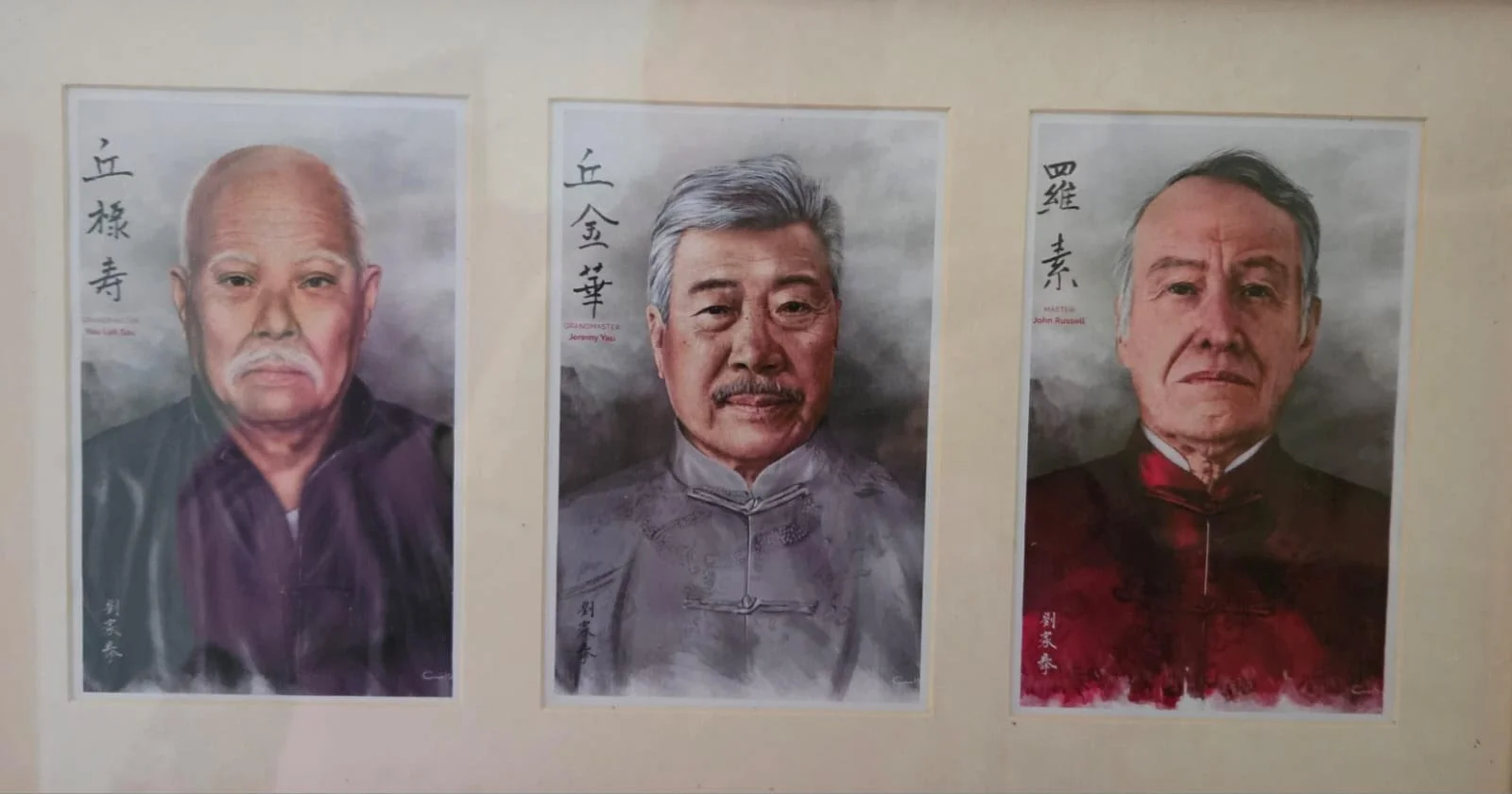
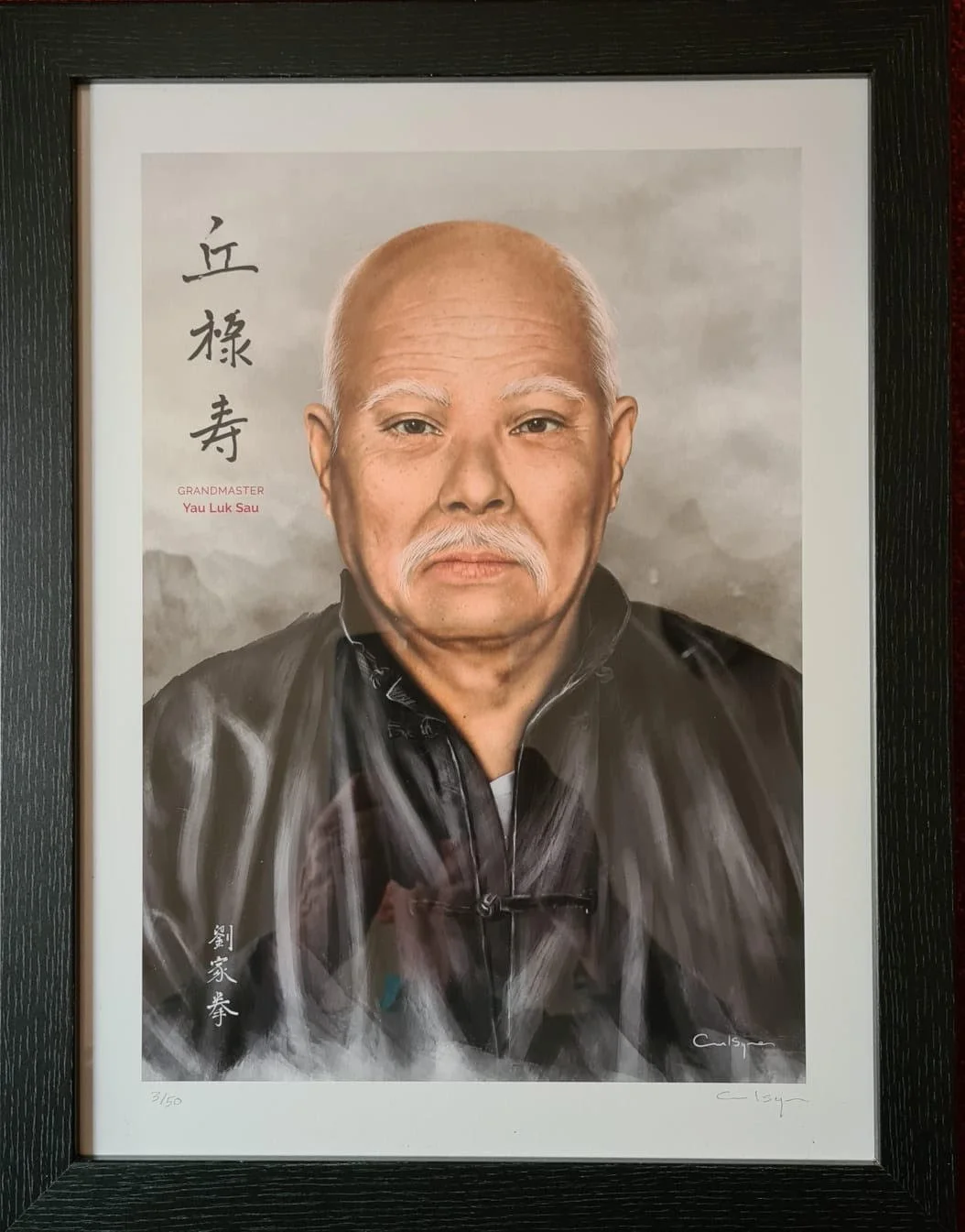
    Towards the end of the 1800's Master Yau's Grandfather (Yau Luk Sau, pictured above) conceived the desire to learn Kung Fu. At the age of 13 he left Kowloon, now in the Hong Kong Special Administrative Region, and travelled to Kong Sai Province where he trained under the Master Tang Hoi Ching. Nine years passed before he was given the right to teach independent of Master Tang. Master Yau's Grandfather subsequently met the Master Wan Goon Wing with whom he continued his studies for a further six years, and whom he served as son until the latter's death. On his return to Kowloon, Master Yau Luk Sau taught only his family and close friends before opening his club to the public. During this time Master Yau commenced his training at the age of six. The training was conducted at the village community centre in Kowloon City (Gau Lung Sing) just outside the famous Walled City. His training continued for 4 hours a night 360 nights a year for 15 years. 

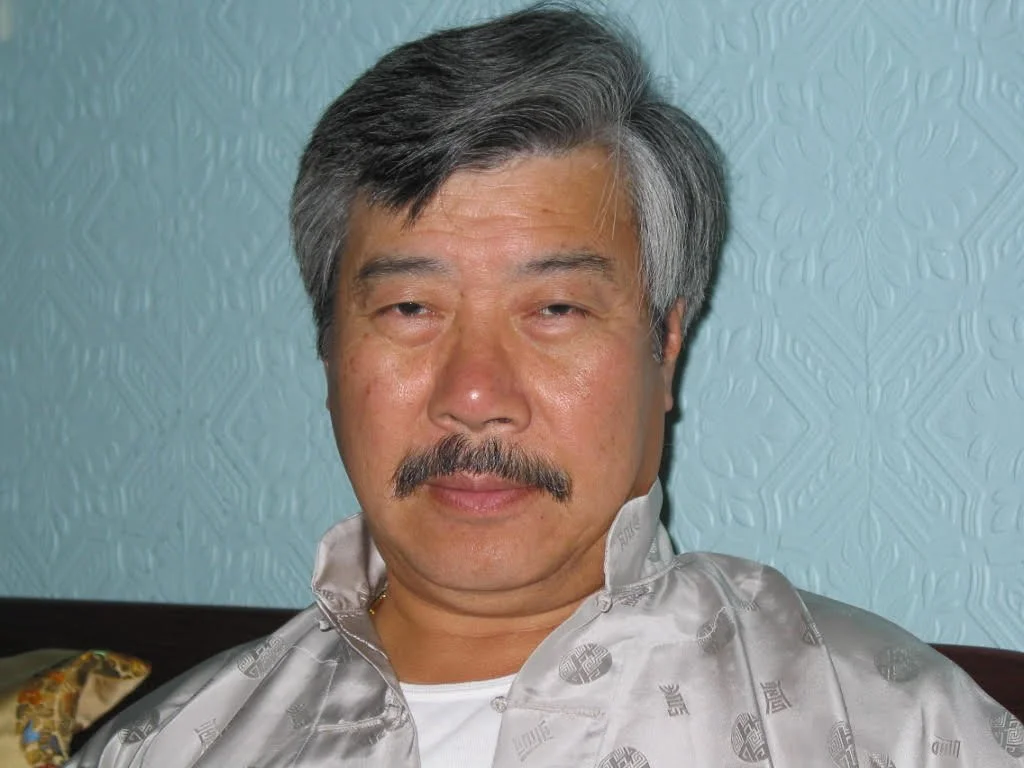
    Master Yau brought the style to the United Kingdom in 1961. The British Kung Fu Association was set up in 1973 and Master Jeremy Yau, being the keeper of the Lau Gar style, was invited to be the Chief Instructor. Subsequently Lau Gar has become Britain's most popular form of Kung Fu.

  • Martial Art styles, and kung fu in particular, are classified by using pairs of contrasting words such as 'external' or 'internal', 'hard' or 'soft', 'long' or 'short', 'northern' or 'southern'.

    Since these descriptions often lead to confusion the following explanation helps you to understand and define 'Lau Gar'.

    External styles emphasise the training the fighting techniques, conditioning the body and in training the more obvious forms of strength. They are said to rely primarily on external strength to generate power. Internal styles, on the other hand, emphasise training to strengthen the internal organs, improving and conditioning the circulation of Chi and in training the mind. They derive their power through this cultivation of internal energy rather than through the employment of muscular force. There are really only a few internal styles such as Taijiquan (Tai Chi Chuan), Baguazhang (Pakua Palm), and Xingyiquan (Hsing Yi Kung Fu). 

    A kung fu style can be classified depending which aspect is trained first. Lau Gar, typical of most forms of Shaolin kung fu, is classified as an external style because of its emphasis on the external forms of training.

    Lau Gar is a 'External' style
    A 'hard' style will feature blows which are seen to be powerful by an observer and results in bruises and broken bones, plus internal damage if the boxer is good enough and forceful blocks to deal with a forceful attack. A 'soft' style will feature blows which are delivered in a relaxed manner and will damage an opponent internally without causing surface bruising or broken bones. It will also turn a forceful blow aside by non-forceful means such a deflection and yielding to the attack in order to use the opponent's energy against them. A style can also be classified on the appearance of the sets, if they are brisk and forceful then they are said to be hard. Lau Gar tends to be hard although it should be emphasised that even hard kung fu styles incorporate a degree of internal training. 

    Lau Gar tends to be a 'Hard' style
    Styles classified as 'long' make use of movements are fully stretched. 'Short' styles use movements that are tight and blows that move short distances. 

    Lau Gar is a 'Short' style
    Drawing a distinction between kung fu styles by describing them as 'northern' or 'southern' is not only a distinction of geography but also of the techniques and methods themselves. Of course referring to a style as 'northern' refers to the geographic origin of the origin of the style but has also come to mean styles that include tumbling routines, very mobile stances and having an emphasis on dynamic kicks (often thrown to high targets). Referring to a style as 'southern' indicates that the style originated in South China. It also infers that the style emphasizes short, fast hand movements from stable low stances and low licks. 

    Lau Gar is clearly a 'Southern' style
    Every true traditional martial art is a blend of the 'external', 'internal', 'hard', 'soft', 'long' and 'short'. Moreover such styles will also contain movements which have no fighting application, being designed for improving the health of the practitioner. There is also an argument that states that at the highest stages of kung fu practice there is no distinction between internal and external concepts. 

    In conclusion Lau Gar can be said to be a Southern Kung Fu Style being External and Hard in nature.

  • From the earliest times Shaolin Kung Fu has featured five styles derived from animal movements called the 'Ng Ying Ga'.

    This article explains what the five animals are and what characterises the kung fu movements based on them Each of the five animals is said to embody specific characteristics and the styles based on those animals were developed to have distinguishable but complimentary movements. The five Shaolin animals are: 

    Dragon, Tiger, Leopard, Snake and Crane 


    Dragon

    The Dragon ('Lung') style represents the cultivation of the spirit. Pronounced back arches, side horse stances and twisting body postures feature strongly in the style. Flexibility and graceful movements are stressed. 


    Tiger 

    The Tiger ('Fu') does not need to defend, it is the ultimate predator. It has no evasion techniques, no blocking or defence. In any confrontation it leaps into attack going for the quick and direct resolution of the conflict. The Tiger uses any simple and direct approach. Its techniques and methods are easily understood with not a lot of strategic thinking or planning; and absolutely no preparation. The Tiger is purely reactive. The tiger style emphasises the training of the bones and has movements characterised by use of the shoulders and the waist held strongly. 


    Leopard 

    The Leopard ('Paau') style represents bravery and martial ferocity. It requires the development of strength and features a strong waist and lower extremities. The leopard style also requires the development of power and speed and swift penetrating strikes. 


    Snake 

    The Snake ('Se') style emphasises the development of 'chi' and employs highly accurate strikes to vital areas. Classic snake style is characterised by the use of flexibility, elasticity and diagonal movements. Snake style attacks employ shooting hand attacks striking to the opponent's venerable regions. To practice Snake the practitioner must spend a lot of time working on accuracy and precision. He/she must be 100% in timing, distancing, effort, target and opportunity. They may use some distracting, swaying motions, occasional feints (each executed as if it were a real attack, which it could be) but that is as complex as it gets. 


    Crane 

    The Crane ('Hok') style is characterised by training of the sinews. It requires quick movements and a well developed sense of balance and practitioners will make use of deflecting, jabbing, hooking and poking movements frequently to an opponent's vital areas. Long arm attacks and use of the waist to generate power are combined to form a graceful style that overcomes aggressive attacks by skilled, almost passive, deflections. The Crane does not attack only counter attacks. It would do this from any angle except the front. It would always side step the attack, possibly using its wings to mask the movement, change direction again, possibly to deliver a technique to the attacker. It is a master of evading supported by blocking and redirection. It would seek to frustrate its opponent, helping it to defeat itself. 

    As a style derived from the Shaolin Kung Fu, Lau Gar also incorporates movements based on the Shaolin 5 animals.

  • Origins: Tai Chi belongs to the internal school of martial arts and has enjoyed centuries of popularity throughout China.

    The story of Tai Chi begins with its founder Chang San-Feng, a Taoist who is reported as having lived either during the Sung (960-1279) or the Yuan dynasty (1271-1368).

    According to legend, one day while strolling through the forests surrounding the Wu Tang Mountains in China's Hubei Province, Master Chang witnessed a snake engaged in combat with a crane. Master Chang was impressed with the skilful way the snake was able to dodge and counterattack the larger, more powerful crane. However, there is very little documentary evidence relating to the exact origins and a reliable historical account is not possible. Today Tai Chi is seen as a practical technique for health and healing, relaxation and martial arts and as such is spreading out of China to other parts of the world.


    Principles:
    Tai Chi consists of a series of continuous, smooth and graceful yet purposeful movements linked together to produce a standard form or routine. The principles of the Tai Chi forms are to move in a relaxed manner using concentration and breathing to direct each posture. In this way, we can improve overall strength and agility in the legs, relaxation in the upper body and suppleness in the waist. The waist is a very important feature of Tai Chi since it acts as a pivot for the body, developing fluidity, balance and power.

    Movements are rounded to maintain stability and to keep the joints open and muscles relaxed. This structure facilitates the passage of Chi or vital energy throughout the body. Tai Chi Chuan means "Supreme Ultimate Hand Fighting". Tai Chi as a martial art has a simple yet essential theory; the use of softness (yin) to overcome hardness (yang) and conversely, the use of hardness to overcome softness. Therefore, attacks are not blocked directly, but are diverted or redirected using evasion. To develop Tai Chi as a martial art requires considerable anticipation, speed, stability and relaxation. In training towards this, pushing hands and compromising techniques can be utilised.

    Since the natural world comprises both soft and hard, the art must also encompass these two forces to work in harmony with the body. A practitioner must be strong and yet soft, show relaxation and concentration and display flexibility with solidity. This is more eloquently put in the translation of the Chinese character: "be still as the mountain and flow like the great river"

    Is Tai Chi a martial art or a form or exercise?
    It would be incorrect to say Tai Chi is either one thing or another. It is a form of exercise, but it is also important to consider it with martial aims in mind. In our class we do teach Tai Chi as a martial art, with conditioning and exercise. One of the most common errors is to ignore the martial aspect- at the time of its development; Tai Chi was a deadly art. It would be unwise for the student to forget this historical fact, because it is within the context of life or death struggle that the techniques of Tai Chi were refined over the centuries.

    What are the benefits of practicing Tai Chi?
    There are numerous benefits of practicing Tai Chi. If practiced regularly, conscientiously and correctly then the benefits are enormous. Health wise, Tai Chi is not a quick fix and the greatest benefits will be achieved long term. Among the most apparent health benefits are an increase in general health and fitness, greater stamina, longevity, greater mental clarity and calmness and increased physical capabilities. 

    Five aspects of training: 
    Tai Chi contains five main aspects of training:

    • 1. Hand Form 

    • 2. Pushing Hands 

    • 3. Self Defence 

    • 4. Weapons forms and Applications 

    • 5. Internal Strength 

    1. Hand Form consists of a series of flowing martial movements which have been joined together to create the smooth soft solo exercise which Tai Chi is so well known for. The movements in the form have been modified from self defence techniques and are sometimes quite obscure. The form emphasises good posture, aligning & coordinating the body correctly and relaxation & focus. 

    2. Pushing Hands is the name given to a group of partnered exercises which put into practise an interchange between yin and yang. Here we begin to develop some of the skills which are used in Tai Chi self defence. These include footwork, balance, coordination, sensitivity, redirecting force and issuing force. More advanced is free pushing which is an unstructured interplay and free-wrestling adds in locks, sweeps, throws etc. 

    3. The practice of Tai Chi Self Defence begins with learning to apply the movements of form to particular prearranged attacks. Once these have been mastered we can vary the attack hence introducing a degree of spontaneity to the training. Combining these skills with the free-wrestling enables sparring practise to be embarked upon. Ultimately the student can continue to full contact sparring for which conditioning training and fitness work is essential. 

    4. The Tai Chi Weapons are the Sabre, Sword and Spear. Each has its own training syllabus including form, self defence techniques, sparring and auxiliary exercises. 

    5. Internal Strength or Nei Kung consists of two sets of exercises - 12 Yin and 12 Yang which strengthen the body and improve relaxation and coordination. They are the bedrock of the system and have therapeutic and meditation aspects also.

  • The spiritual development is brought about by Chi Kung training. In a basic form Chi Kung consists of standing in certain positions while using breathing and visualisation to increase and channel chi energy around the body. 


    What is Chi Kung?
    Chi Kung is an exercise system from China that combines stillness, or gentle movement, with calm regular breathing. Although there are many different styles of chi kung, movements themselves are usually easy to learn. The challenge comes from coordinating these with the correct way of breathing. 

    When this is achieved, the body's natural energy is circulated far more efficiently than would normally be the case. With daily practice, therefore, chi kung can strengthen the overall state of health and increase resistance to illness. Each move works all of the body with some moves especially beneficial for specific parts of the body. The principles are the same as Tai Chi so doing Chi Kung will improve the hand form as well as pushing hands exercises. Chi Kung has the same advantage as Tai Chi in that it is so multifaceted. If you want to ignore the energy aspects of it you can just attribute it to respiration. Chi Kung will improve your Tai Chi but also the classes help people relax. Tai Chi and Chi Kung are complimentary so neither class undermines the other.

  • What is it?
    Kickboxing has become one of the most popular Martial Art training methods throughout the UK and worldwide. Kickboxing seems to be very popular amongst people of all ages.

    It is an effective system of training methods that get people punching and kicking with some power in a short space of time.


    Where does it come from?
    Well, kickboxing is a stream lined number of basic techniques taken from a traditional martial art style. It had to come from somewhere and as most traditional martial art styles feature kicking and punching of some kind that is where it is derived from. However kickboxing is a relatively new concept of Martial Art and has only come about in the 1970’s.

    Training
    Techniques in a nut shell include the following;
    Hand Techniques – Jab, Reverse, Hook, Upper Cut and Backfist.
    Foot Techiques – Front, Round, Side, Hook, Back, Axe, Spinning and most other kicking variations including jumping.

    It is not just the techniques but also the concept in which they are trained.

    Kickboxing training consists of line work, pad/bagwork and also sparring.

    The kickboxing workout includes some of the following; general exercise, body conditioning, skipping, running and can also incorporate some form of weight training.
    An important part of the kickboxing training as any other traditional martial art training is sparring. Sparring teaches you timing, speed and accuracy, the ability to hit a moving target and also to be hit.

    Competition
    There is also a competition aspect for kickboxing which is very popular.
    Lau Gar has become famous from the success of its competition fighters and has produced many World Champions.
    There are a number of different types of contact, full, light and semi contact (see competition section for definitions). A tournament circuit for Semi and Light contact exists throughout the UK.

    Some Lau Gar practitioners have incorporated Kickboxing as an additional part of their Lau Gar Training. 
    However over the years some clubs have geared towards the competition aspect and now solely teach just Kickboxing.

    Kickboxing is an enjoyable social activity which keeps you fit and healthy.

  • Modern Wu Shu is the national sport of China. The term wushu consists of two Chinese characters (wu), meaning "War Art", martial or military, and (shù), which translates into art, skill or method. Together these form "wushù" or "martial art".

    Wushu, also known as modern wushu or contemporary wushu, is both an exhibition and a full-contact sport derived from traditional Chinese martial arts. Created in the People's Republic of China after 1949, wushu has spread globally through the International Wushu Federation (IWUF), which holds the World Wushu Championships every two years; the first World Championships were held in 1991 in Beijing and won by Clark Zhang.


    Wushu is composed of two disciplines: taolu (forms) and sanda (sparring) [1]. Taolu forms are similar to gymnastics and involve martial art patterns and manoeuvres for which competitors are judged and given points according to specific rules. The forms comprise basic movements (stances, kicks, punches, balances, jumps, sweeps and throws) based on aggregate categories traditional Chinese martial art style and can be changed for competitions to highlight one's strengths. Competitive forms have time limits that can range from 1 minute, 20 seconds for the some external styles to over five minutes for internal styles.

    Barehanded 

    • Changquan (Long Fist) 

    • Nanquan (Southern Fist)

    • Taijiquan (Taiji Fist)

    Short Weapons  

    •  Dao (single-edged sword)

    • Jian (double-edged sword)

    • Taijijian (Taiji double-edged sword)

    • Nandao (Southern single-edged sword)

    Long Weapons

    • Gun (Staff)

    • Qiang (Spear)

    • Nangun (Southern Staff) 


    Most events were first set up in 1958. These events are performed using compulsory or individual routines in competition. Compulsory routines are those routines that have been already created for the athlete, resulting in each athlete performing basically the same set. Individual routines are routines that an athlete creates with the aid of his/her coach, while following certain rules for difficulty, number of acrobatics, etc.

    In addition to events for individual routines, some wushu competitions also feature dual and group events. The dual event, also called duilian, is an event in which there is some form of sparring with weapons, or without weapons or even using bare hands against weapons. The dual event is usually spectacular and actions are choreographed before hand. The group event, also known as jiti, requires a group of people to perform together and smooth synchronization of actions are crucial. Usually, the group event also allows instrumental music to accompany the choreography during the performance. The carpet used for the group event is also larger than the one used for individual routines.


    Previously, international wushu competitions most often used compulsory routines, while high-level competitions in China most often used individual routines. However, after the 2003 Wushu World Games in Macau it was decided to opt for individual routines in international competition with nandu; difficulty movements) added for additional point bonuses.
    There is some controversy concerning the inclusion of nandu in wushu because many of the movements created for the specific events are not originally movements used in those styles. In addition the number of injuries which have resulted from the inclusion of these nandu have caused many people to question their inclusion. Those who support the new difficulty requirements follow the assertion that they help to progress the sport and improve the overall physical quality of the athletes.

    Another modern form of wushu is called sanda (sometimes called sanshou or Lei Tai), which is a modern fighting method and sport influenced by both traditional Chinese boxing, Chinese wrestling methods called Shuai Chiao and other Chinese grappling techniques such as Qin Na. It has all the combat aspects of wushu. Sanda appears much like kickboxing or Muay Thai, but includes many more grappling techniques. Sanda fighting competitions are often held alongside taolu or form competitions.

  • Sanshou (Chinese:, lit. free hand) or Sanda (Chinese:, lit. free fighting) is a modern Chinese hand to hand combat, self-defence system, and combat sport.

    Not seen as an independent style, it is rather considered just one of the components of Chinese martial arts and is normally taught alongside other wushu. The term Sanda has a longer history and is more commonly used. Sanshou was the official name given to the martial art when it was formalized and standardized by the Chinese government. Later the official name reverted back to Sanda. 

    It is composed of some aspects of traditional martial arts fighting styles in China, but mainly based on scientific one-on-one combat efficiency. Sanshou is composed of Chinese martial arts applications including most aspects of combat including striking and grappling. Sanda tournaments are one of the two sport wushu disciplines recognized by the International Wushu Federation.

    Sanshou's history involved barehanded or "lei tai" fights in which no rules existed. However, as a competitive event sanshou developed in the military as these bouts were commonly held between the soldiers to test and practise barehanded martial skills, ability and techniques. Rules were developed and the use of protective gloves etc. was adopted. It was originally used by the Kuomintang (KMT) at the first modern military academy in Whampoa in the 1920's. Later it was also adopted as a method by the People's Liberation Army of China. One can see Sanshou as a synthesis of traditional Chinese kung fu fighting techniques into a more amorphous system and is commonly taught alongside traditional Chinese styles which Sanshou techniques, theory and training methods are derived from. The emphasis of Sanshou is on realistic fighting ability. 

    As an unarmed self-defense, close combat system, Sanshou includes DA punches, kicks TI and grappling Shuai, Na (throws, locks, chokes)

    Sport
    As a sport, Sanda is practiced in tournaments and is normally held alongside taolu events in wushu competition. For safety reasons, some techniques from the self-defence form of Sanshou such as elbow strikes, chokes, and joint locks, are not allowed during Sanda tournaments. Furthermore, it is possible to defeat the opponent by moving (whether by throwing, striking, or otherwise pushing) him outside the ring. Fighters are only allowed to clinch for a few seconds. If the clinch is not broken by the fighters, and if neither succeeds in throwing his opponent within the time limit, the referee will break the clinch.

  • Chin Na or Qinna is a term describing techniques used in the Chinese martial arts that control, lock or break an opponents joints or muscles/tendons so he cannot move, thus neutralizing their fighting ability. 

    Chin means to seize or trap, na means to lock or break and while those actions are very often executed in that order (trap then lock), the two actions can also be performed distinctly in training and self defence. 


    There is quite a bit of overlap between Chin Na theory and technique with the branches of traditional Chinese medicine. 

    Within Lau Gar forms there are a wealth of techniques which lend themselves to Chin Na applications. The knife defence has numerous Chin Na applications, however the forms need to be studied and broken down to really appreciate the vast array of methods. 

    Chin Na methods give the ability to lock any joint from the wrists, elbows, shoulders, etc. right through to finger locks and neck restraints.

    All methods should have a Yin or Yang element to them. For example most people see Chin Na techniques as "just a joint lock". This is far from the truth. A manipulation of a joint for restraining purposes would be classed as a "Yin - Yielding" however the "Yang" aspect of the technique would be destruction of the joint either through dislocation or a break. 

    The important factor with Chin Na is that a lock should never be pre planned, what is needed is the ability to "stick to and read" the attacker's limbs and therefore you will have a Chin Na application for whatever is presented to you. 

    Lau Gar itself is designed to be very direct and smash through whatever is in its way. But as with all arts there are tools for any occasion with the system. Chin Na being one of them. 

    When you extract the Chin Na applications form the forms they can also be used as an "entry method" for follow up strikes. That is to say that to hit the body we must first get passed whatever limb is heading our way i.e. their fist, foot, etc. We can either block or manipulate the joint or limb to allow us access to the targets we would like to hit. Therefore Chin Na can help to achieve our goals. 


    Lau Gar Chin Na teaches correct body mechanics so that the techniques can be implemented efficiently whilst keeping you in a safe position out of "the attacker's line of fire". 

  • You have probably seen lion dances at Chinese New Year. Two men inside a lion costume performing acrobatic movements to the crashing of cymbals and the banging of drums. In fact the lion dance forms a part of many Chinese festivals and special occasions such as weddings and even the opening of businesses and restaurants. By way of an example anyone attending the recent BKFA 30th Anniversary celebrations will have been treated to a lion dance. 


    The main reason the dance is performed is that it is said to ward off evil and bring good fortune. To aid in this process it is typical for loud fire crackers (rather like strings of 'bangers') to be lit. This is less common in the UK because of legal, health and safety issues surrounding their use. 

    Lion dancing is physically demanding requiring agility and, when practiced at its highest form, acrobatic ability. Kung fu clubs have long been associated with lion dancing as the lion dance incorporates various kung fu derived stances, kicks and other footwork in its routines. Of course kung fu practitioners should also have the physical attributes required to manipulate the heavy lion's head which can be surprisingly heavy and difficult to use. 

    Just as demanding is the tail of the lion which necessitates that the practitioner be bent over for long periods of time. The person playing the lion's tail can also serve as a base for the person manipulating the head to stand on adding to the demands of playing that role. At its highest level lion dancing is similar to sports acrobatics in that the tail forms the base for the top or head to balance on. Balances can be performed standing or even running between poles high above the ground. 
    There is another reason why the lion dance is so closely associated with kung fu clubs. In traditional clubs the students did not pay a fee. Instead, the club raised all its funding for the year by competing in special lion dancing competitions held during the Chinese New Year. 

    Even today the skill of the kung fu club's lion dancers serves to show the club's spirit and the team's ability to perform an impressive lion dance is a matter of pride and is taken very seriously. 

  • Rather surprisingly China does not have any native lions, which makes it seem rather surprising that lions should form such a key part of the Chinese culture. For example, I'm sure you will have seen 'temple lions', pairs of lions which stand at the entrance to key buildings such as temples or that are sold in miniature as ornaments. So where did the lions come from? Well the answer lies in the same place that kung fu owes its origins to - the Silk Road. Many cultural influences passed between India, China and surrounding countries via this trading route. There are those that argue that it was in part the demands for better self-defence when travelling this route that lead to the development and spread of the martial arts. 

    Perhaps because China has no lions of its own the form of the traditional Chinese lion bears little resemblance to a real lion. In fact the lion used in the lion dance has a single horn in the middle of its head! None the less, the lion is a strong symbol of strength, courage and wisdom. 

    Lion dancing is an ancient ritual dating back to the Tang Dynasty (618-906 A.D.) and although its exact origins are unclear it can be traced back to two historical possibilities: 

    The first possibility is related to bands of Persian performers who roamed China. During the Tang Dynasty the Chinese exchanged cultural influences with other countries and the lion was one of the many acts in the Persian 'new day' festival. 
    The second possibility is that lion dancing can be traced to the annual cleaning of the imperial palace. Each New Year the palace was cleaned; physically and spiritually. Men dressed as twelve sacred animals made three passes through the palace. The lion was one of these animals. This purification ritual extended to Buddhist practices and, as we all know, there is a close link between Buddhism and the formation of the Chinese martial arts and kung fu in particular. 

    Of course there are myths associated with the lion. One such story is that a Tang Dynasty emperor had a dream in which a strange creature saved his life. The next day the emperor described the dream to his ministers. One of the ministers explained to the emperor that the strange creature resembled a lion which came from the west. The emperor ordered his ministers to recreate the lion he saw in his dream and the lion subsequently became a symbol of good luck, happiness and prosperity.

    Another myth describes the events surrounding a village that was being overrun by rats. One day a lion appeared and ate all of the rats (odd, considering China does not have native lions!). Once the lion had eaten all the rats it turned on the villagers. A Buddhist monk in the village is said to have captured the lion and taught it Buddhism. Following a remarkable personality change the tame lion served to protect the village it once terrorised. There is actually a variation on this story that says that the villagers dressed up in lion costumes and made a lot of noise to scare off the lion - hence the lion dance. 

    Another myth concerns the goddess of mercy, Kwan Yin. In this story the lion was a heavenly creature that was fond of causing trouble and practical jokes. Displaying very poor judgment the lion played a joke on the Jade Emperor who was so enraged he promptly cut off the lion's head. Kwan Yin felt sorry for the lion and decided to help him. She used a long red ribbon to reattach the lion's head and brought the lion back to life. Kwan Yin also gave the lion its horn which it could use to fight with and also a mirror to frighten away evil spirits (so that's where the horn comes from!). 

    In this article we have had an introduction to lion dancing and seen that is it a tradition closely associated with kung fu schools. We have also seen that its origins and history are complex and difficult to pin down definitively. What we can say though is that it is a key part of Chinese cultural tradition to bring prosperity and good fortune.

  • The most basic lion dance team has 5 people: 

    • 2 members for the lion 

    • 1 drummer 

    • 1 gong player 

    • 1 symbol player 

    There is an optional 6th or even 7th member referred to as a 'funny person', 'laughing Buddha' or 'big headed Buddha'. The Buddhas (or 'daai fut') wear a painted full-head mask with a large smile and either a traditional kung fu uniform or a monk's robe. They can also have a pillow is under their clothes to give them a Buddha-like pot belly. Their job is to interact with the crowd and tease the lion with a fan or a ball.

  • Below you will find some of the details of the dance itself and the significance of some of the movements. 

    The lion dance can be performed in a number of different ways but each version is based on a several basic parts or sequences.

    The sequences can be listed as: 

    • A sleeping sequence

    • An opening sequence

    • A playing sequence

    • A searching sequence 

    • A fighting sequence

    • An eating sequence 

    • A closing sequence

    • A final sleeping sequence

    Any given dance may vary by including or excluding one or more of the sequences but there will always be an opening sequence, an eating sequence and a closing sequence. 

    The sleeping sequence has three sections: sleep, waking up, and cleaning. The lion cleans each part of itself before shaking its head three times and rising. This whole sequence represents the awakening of the spirit, getting rid of the old and renewal. Having completed this section the lion embodies a state of holy purification. 

    During the opening sequence the lion bows 3 times as a sign of reverence. The 3 bows can be traced back to the three passes of the twelve animals in the ancient custom of cleansing the emperor's palace. If the lion has to enter a building it is usual for the lion to bow 3 times before any alter or shrine that may be present.

    The playing sequence is fairly freeform and it is during this sequence that the best skills of the dancers can be demonstrated. This might involve climbing or balancing movements or playing with a ball which represents a pearl. 

    After playing the lion starts to search for food. This part can be quite demanding because the food is often placed in a difficult to reach location and it represents a sort of test of strength.

    It is not at all uncommon for the dancers to have to climb over obstacles such as benches or poles to reach to food. In fact, tremendous athletic and acrobatic agility is required for this sequence. It is usual for the lion to jump between small platforms situated on the top of poles high above the ground and for the person playing the head to be carried by or balance on the person playing the tail. 

    If there is more than one lion present it would be natural for a fight to break out between the two lions, and that is what happens. 

    The food is usually in the form of green vegetables such as lettuce that are hanging on the end of a string. The green vegetables (or 'choi cheng' in Cantonese) are a symbol of wealth and good luck. This is a fun part because the lion, or rather the dancer in the head, takes the greens into his mouth where he shreds it. The greens are then shredded and 'spat' over the audience. It is also the part where the dance troupe gets its reward because included with the greens is a lucky red packet containing money.

    It is also believed that during the Ching Dynasty underground fighters whose aim it was to restore the Ming Dynasty used this method to covertly pass messages to each other. 

    In the closing sequence the lion cleans himself again before bowing 3 times. 

    Having finished his task the lion returns to sleep.

  • Although the Lion Dance is very popular amongst kung fu practitioners traditionally it is the Kei Lun Dance that is performed in our style. This article explains some of the differences between the Lion Dance and the Kei Lun Dance. 

    Master Yau explains the finer points of the Kai Lun dance.

    I'm sure you know about the Lion Dance and the Dragon Dance, both of which are very common at Chinese celebrations like New Year. However, there is another dance called the Kei Lun Dance.


    There are 4 Chinese mythical creatures: the Phoenix, the Dragon, the Tortoise and the Kei Lun. Amoungst other things each one of the four represents a position on the compass. The Kei Lun represents the west, the Phoenix the south, the Tortoise the north and the Dragon the east. 

    When translated into English the Kei Lun is often said to be a unicorn but this is probably not a good translation as the creature is quite different from the horse-like animal with a single horn. Kei Lun is also has a number of different Romanisations such as Chi Lin, Ch'i Lin, Jilin and Ki Lin some of which are probably Romanisations of the Mandarin name for the creature. Here we try to use Romanisation of Cantonese when ever possible and Kei4 Lun4 (complete with numeric tone indicators) is the correct form.

    The origins of the Kei Lun as a Chinese mythical animal can be traced to stories such as that about the Emperor Fu Hsi dating back to the 27th century BC. The Emperor was sitting on the banks of a river when a Kei Lun emerged from the water. The Emperor later described the animal as resembling a deer, with an ox's tail, horse's hooves and a short, fleshy horn. The Kei Lun also had magical symbols on its back, which inspired the Emperor to develop the first written language of China. Even today, the performance of the Kei Lun Dance can be regarded as a celebration of the development of the Chinese written language.

    As an aside Emperor Fu Hsi (sometimes written Fuxi and also known as Paoxi) is said to have taught the Chinese to domesticate animals. His early attempts at writing lead to him devising the eight trigrams, eight distinct symbols each constructed out of three solid or broken lines. The eight trigrams formed the basis of the famous book, the I-Ching (Book of Changes) and can be seen in many places today such as the Ba Gua, a lucky charm that is put on the front of buildings to ward off evil.

    Traditionally the Kei Lun is seen as an herbivorous and peaceful animal that will not kill another creature. Because of this they are revered as a holy animal. The Kei Lun Dance is performed to bring prosperity, peace and health and is performed during such celebrations as birthday parties or opening of new businesses. However, the Kei Lun Dance should not be performed during funeral services or a baby's first month celebrations. The Kei Lun is a lucky animal and is even welcomed into peoples' homes, something that would never happen with the aggressive lion.

    The author K.C. Wu describes the unicorn as "'an animal of benevolence, having the body of an antelope, the tail of an ox and a single horn.' And according to some commentaries, the horn is flesh-tipped so that though it looks like a weapon ready for use in self-defence, it is never intended to do injury to others." [1]

    The Kei Lun does not normally live on Earth but rather inhabits heaven. It is said to only appear in our world at the birth of a wise man or philosopher. Kei Lin can live to be a thousand years old.

    There are actually 2 kinds of Kei Lun used in the dance: the Green Creek Kei Lun and the Gao Hua Kei Lun. The Kei Lun Dance is strongly associated with a group of people known as Hakka and is practiced in southern regions of China. The Hakka people often call the Kei Lun the Rooster Lion rather than Kei Lun although both the Rooster Lion and Kei Lun have similar features and dance movements.

    Similar to the lion costume the Kei Lun costume consists of a sculpted head and a fabric tail. Although the Kei Lun head bears a superficial resemblance to that of the lion the two are easily distinguished because the Kei Lun's head is much smaller than that of the lion. Because of this fact the Kei Lun is well suited to the performance of fast movements. The Kei Lun tail can be up to 4 meters in length although it is common for some Kei Lun tails to be as short as 2 meters, particularly for Kei Lun used in competition.

    The Kei Lun dance music is also superficially similar to that of the lion dance as the ensemble consists of a gong, large cymbals and a small drum. Unlike with the lion the Kei Lun drum is hardly noticeable and is not as important as it is in the Lion Dance. Remember with the lion making a lot of noise is central to the performance which is not so with the Kei Lun. The Kei Lun also eats greens during the dance in the same way that the lion does and, similar to the lion, the greens can be suspended in a high location such as at the top of a door. Good fortune is brought when the Kei Lun succeeds in eating the green vegetables and the higher the greens were, the greater the good fortune.


  • Weaponry remains an important part of advanced Lau Gar practice. This article describes some of the most significant weapons we use.

    As you progress through the grades weapons become increasingly important. At first glance weapons practice may not seem to have much direct use in a self-defence environment (let's face it, you are not going to last very long walking down the street with a sword before you attract the attention of the Police - and quite rightly so). 

    However, weapons practice gives you two important things: Firstly weapons practice teaches you principles which can be applied to everyday objects such as umbrellas, walking sticks etc. These can then be exploited successfully in self-defence. Secondly, a weapon is really just an extension of the body. As such weapon training provides an ideal platform for advanced martial art practice requiring strength, speed and coordination. All of these are to the benefit of any martial artist. 

    What follows is a description of some of the more common Lau Gar weapons. The weapons shown are not to scale in reference to each picture.


    Eye Brow Staff or Wooden staff
    One of the first weapons to be taught to Lau Gar students is the wooden staff ('kwan'). The Lau Gar staff is about 6 feet in length and in the region of 3.5cm in diameter. It is made of hard wood and is therefore almost completely inflexible. 


    Broad Sword 
    The Chinese broad sword ('Dan Dao') is a single edged weapon. It can vary in length according to the practitioner's stature but is generally in the region of 90cm long. The blade of the dan dao is quite stiff, unlike some other Chinese single edged swords which can be very flexible. Its origins probably lie in the need for a practical weapon that could be used as a kind of machete should the need arise. Use of the dan dao is characterised by speed and aggression coupled with slashing and whirling movements. There is less emphasis placed on the thrusting movements that are a feature of straight, double edged swords although such movements do occur in Lau Gar dan dao forms. 


    Rat Tail or Throat Locking Staff
    The rat-tail or throat locking staff ('Soar Hou Kwan') is made of hard wood. It is longer than most wooden staffs being around 7 feet long. It is easily identified because it tapers from a thickness of about 5cm at one end to 2.5 - 3cm at the other. No doubt it is the taper that gives it the name 'rat tail'. The rat tail staff is truly a Lau Gar weapon as it is not used by many other styles. 


    Butterfly Knives
    The butterfly knives ('Wu Dip Dao') are very much a southern Chinese weapon. They are more like short swords than knives being roughly the length of your forearm. Each has a blade edges on one side and a closed handle that protects the fingers. There is also a hook on the non-edged side of the blade which allows the practitioner to pivot the knife around so that it runs down the forearm. Rotating, slashing and chopping movements are common with this weapon. 


    Tiger Fork 
    The tiger fork ('Pa Fa') is a key Lau Gar weapon as it is closely associated with the style's founder, Lau Sam Ngan or Three Eyed Lau who was a tiger hunter. The Tiger Fork is in the region of 6 feet in length and has a substantial steel trident or fork at its head. The supporting staff is made of hard wood and is usually very thick. The Tiger Fork is a heavy weapon being in the region of 30 - 40 lbs in weight and requires both skill and strength on behalf of the practitioner. 


    Kwan Dao 
    The Kwan Dao takes its name from its inventor, General Kwan Yu, a central figure in many Chinese myths and legends and a figure that can often be seen in statue form. In fact General Kwan can be regarded as the patron deity of the Chinese martial arts and shrines devoted to him are not uncommon in traditional kung fu schools. Other organisations such as the police also pay homage to him. As an example the main CID office (or 'daai fong') in Hong Kong police stations always have a shrine to General Kwan. The reason he is so revered is that after performing many good deeds during the latter part of the Han Dynasty (in the second century AD) General Kwan was put in command of the Emperor's army. There he forged a reputation for both strength and military genius as well as becoming famed as a defender of the righteous and supporter of the just cause. 


    General Kwan was a very strong man and he decided he needed a weapon suited to his particular needs. Specifically, he wanted a weapon that he could use from horse back or on foot and which would be effective against both foot soldiers and cavalry. 
    The kwan dao is a heavy weapon being about 6 feet in length. The stout hard wood staff supports a large metal blade. The blade usually features a small hook or protrusion about half way down its back edge which can be used to trap opponent's weapons. This is a Lau Gar weapon that requires a combination of skill and strength. 

    Cane Shield 
    ('Tang Pye')


    Spear
    The Lau Gar spear ('chung') is a long weapon being in the region of 7 feet in length. Unlike the spears that evolved in many other parts of the world the Chinese spear is not a throwing weapon. It further distinguishes itself by having a flexible rattan staff rather than a rigid hard wood one. 

    The spear is regarded by many as the oldest Chinese weapon originally developed for use as a cavalry weapon to be used from horse back. However, in kung fu schools it is used as a weapon for practitioners with their feet firmly planted on the ground. Its flexible staff lends itself to some unexpected uses such as slashing movements. That is why it is common to have a pointed, double-edged head which can be used to slice as well as thrust. 


    Additional Weapons
    In addition to the traditional weapons of Lau Gar a handful of other weapons are available to learn within the association and are often taught by the Lau Gar Guardians (see calendar for Guardian Courses). These weapons have been often learned from various Masters following training trips to China.

  • The Weapons and Fighting Gear of Ancient China

    Chinese weapons can be considered to be the origin or mother of all Asian oriental weapons. The ancient monks of Shaolin learned to use anything as a useful weapon. The most popular Chinese weapon was the staff, considered to be the king of all weapons. 

    The most popular Shaolin Kung Fu 'tool' was the staff. A long stick that had a variety of uses and purposes. It is a multi-purpose implement that can be used for many things other than self defence. A staff is used as a walking stick, to carry loads on your back, carry and transport two water buckets, as a lever, tent pole, writing implement (in the sand) and many more. This is also the weapon that almost all Chinese martial arts consider to be "The Father of all Weapons". It is also highly effective and recommended for all martial artists to learn.

    There were of course many staff types as there are different woods, people and ways of using. But in general most staffed weapons can be but into 5 specific sizes(general lengths - all Shaolin weapon dimensions were measured in 'natural' measurements relating to the user);

    Dragon Staff (app 1½ person lengths or 8 to 9 foot)
    Shaolin Staff (app 1 person length or 5½ to 6½ foot [also Rat Tail Staff, very flexible, Bai La Wood]) 
    Carry Staff (app ¾ person length) 
    Cudgel or Walking Stick (app half person length and very stout) 
    Flute, Ruler (app fore arm to fore arm and hand length)

    Virtually any item that comes to hand can be used as an item of defence. 

    Clubbing or blunt weapons were popular among the Shaolin Monk Kung Fu practitioner for several reasons. Because of their spiritual beliefs they didn't believe in hurting or killing. Although a blunt weapon could hurt, it was difficult to kill someone with a staff or stick. What you would most likely do is subdue the attacker and hurt them. Many of them originated as farm tools and then became more refined and specialised with time.

    Flexible weapons were the most difficult to master and the least understood. Few students ever mastered or took the time and discipline necessary to learn a flexible kung fu weapon. When we think about flexible weapons, we think of the 9 ring chain whip, the three sectional staff and many others. These weapons were the complete opposite to the sword and staff. They required a great deal of talent and training to master. 

    Some weapons of the China were designed to be used from a distance. Distance is preferable as a good defence and for secret attacks. Shaolin monks are normally not in the business of secretly attacking people, so these were rarely used and in very extreme circumstances. These weapons were common amongst vagabonds, assassins and ninjas. They were considered to be weapons of unfavourable reputation. Shaolin Kung Fu and Chinese Martial Arts have 4 basic weapons: The staff, the broadsword, the spear, and the straight sword. These are the 4 basic weapons of Kung Fu and Chinese Martial arts and one that all serious martial artists should master.

    • The Staff - The Father of All Weapons

    • The Broad Sword - The Marshall of All Weapons

    • The Spear - The King of All Weapons

    • The Straight Sword - The Gentleman of all Weapons

  • Welcome to the frequently asked questions section. We hope to address many of the questions you might have regarding Lau Gar Kung Fu.

    If your specific question is not answered here, then please do not hesitate to contact us and we will endeavour to help you.

    Why do martial arts?
    People do martial arts for various reasons. Some people train in the arts for self defence, fitness, confidence, others for competition or simply because they have a passion for what they practice. It’s up to you to decide what you want to do.
    Martial arts  can give you a vast array of principles and techniques to work your body and mind. To become good in anything, you need to practise and martial arts can help improve your quality of life .

    How is Kung Fu different from Karate, Judo, or Tae Kwon Do? 
    Judo is a Japanese sport that involves primarily throwing and grappling. 

    Karate is a Japanese martial art which uses hard hand blocks, straight techniques, lots of power.

    Tae Kwon Do is a Korean martial that emphasizes the feet as weapons and is also power oriented. 

    Kung Fu is a Chinese martial art that has both hard and soft styles. Kung-fu uses hand and foot strikes, throws, grappling holds, locking, weapons, and self defence. It is therefore a more broad and complex system of combat than many other styles above.

    Kung Fu is thousands of years old, the styles listed above are relatively new and are said to be derived from Kung Fu.

    What is Lau Gar Kung Fu? 
    A Chinese martial art that uses kicks and punches together with grabs and joint locks to form a well rounded self-defence system. Advanced practice also includes the use of traditional weapons such as swords and sticks. 

    Kung fu is said to have its origins in the 6th century AD. Lau Gar Kuen is a form of kung fu from Southern China. 

    What does "Lau Gar Kuen" mean?
    "Lau Gar Kuen" in English means:
    Lau    = The family name
    Gar    = literally translated as family,
    Kuen = Fist. short for Kuen Fa (fist movements).
    Hence Lau Gar Kuen translated means "The Lau Family's Fist methods".

    Who is Lau Gar kung fu suitable for? 
    Lau Gar kung fu is suitable for people of all ages, male or female. Our classes are tailored to take account of your age and physical capabilities so there is no need to worry whether you are young or old. 

    The best approach is to visit one of our registered clubs and speak to the local instructors and they will address your concerns. See Club Directory 

    Where is the nearest club?
    See Club Directory

    Should children study Kung Fu? 
    In general, yes. Some of the possible positives would be control of aggressiveness, instilling self-confidence, self-respect and self-control, as well as the obvious self-defence benefits. Our instructors have all undergone anatomy and first aid courses and therefore appreciate the fact that the joints and connective tissues of children are more vulnerable to injury than those of adults.

    Do I have to be fit to do Kung Fu?
    Some people are fitter than others but everyone has a base level of fitness which we will help you improve upon. The classes are designed to help individuals become stronger; improve your flexibility and your general fitness. You may also find that you will lose weight, improve your shape and be generally healthier, through practising martial arts. While there are exercises that all students will do, some parts of the training will be catered specifically to the condition and background of each student.

    Do I have to be flexible to do Kung Fu?
    Basically, no. You don't have to be flexible to start out in martial arts, because you will gain flexibility the longer you practice. 

    Are there specific enrolment times?
    No. The majority of Clubs allow new students to enrol at any time. 

    What forms of training are available within Lau Gar? 
    There are really 3 aspects to Lau Gar training: 

    • Traditional training 

    • Self-defence training 

    • Kick boxing and competition fighting 

    All of which involved some degree of physical contact. The risk of injury during traditional and self-defence training is minimal. The aim of these types of training is to develop your technical skills.  As you progress you will be expected to demonstrate your ability to defend yourself.

    Sparring is optional in most cases, however you will need to demonstrate a basic level of sparring for intermediate examination. Sparring is kept under strict supervision and is controlled.

    Students who really want to pursue the fighting aspect can opt for kick boxing and competition fighting. This type of training offers a higher degree of contact and the risks of getting injured are higher. Again however, levels of contact are controlled and all fighters wear protective equipment such as gloves, foot and shin pads, head guards and gum shields. See Kick boxing 

    We also undertake a form of fighting which we call 'sticking hands'. This advanced form of fighting is for brown and black belt grades only because there is no protective equipment and a wide range of techniques are permitted. See Chi Sau.

    What should I wear at my first lesson? 
    We recommend a loose fitting t-shirt and tracksuit bottoms. 

    Foot ware -Given the wide selection of club venues - i.e. Sports halls with matted areas vs. Community halls .each club will have its own policy to ensure students are safe. 

    Some will accept trainers, some specialist martial arts training shoes or bare feet. 

    All clubs will ask that your training kit be clean and that you ensure your toe and finger nails and kept short. You are likely to get hot when training so please bring some water or other re-hydrating drink (Please avoid bringing jewellery to the classes.) Members uniform shop.

    How regular should I train to get the best benefit?
    Put simply  “You reap what you sow“, The more regular and harder your work, the better the benefits . Always remember attend class to learn, and practise in your own time to retain, this approach seems to be the difference between those that really make Kung-fu a way of life.

    Are there any health benefits?
    The combination of mental and physical movements and exercise relieve problems that may result from injury or illness. Kung-fu can help you cope or overcome;
    Stress, Poor circulation, Joint problems, Constipation, Fatigue, Abdominal tension 
    High blood pressure, Back pain , Muscular tension, Muscle spasm, Sciatic pain and more...

    Is there a grading system in Lau Gar? 
    Yes, there is a grading system. There are 8 belts, or rather sashes, from white to black. Beginners have no sash until they take their first grading. Typically after about 12 weeks training.  See Grading (log In required)

    How long would it take me to get a black belt?
    It will take as long as it takes. It depends on how you train - It obviously likely that a person who trains 3 times a week regularly challenging mind and body , is more likely to achieve is belt sooner than someone who does the bare minimum. 

    That said from our experience 4-5 years to is probably the average time frame to reach 1st degree black.

    Is private tuition available?
    Private one on one or small group classes are available. These classes can help to advance students that are focusing on a particular area of interest in their study of martial arts, or to work out a problem they feel they have in their training. Students approaching a grading or tournament may also find these classes of importance. They are also useful for people wishing to increase their fitness with a personal training work out.  Just ask your Club instructor for details.

    Why should I become a member of BKFA?
    By becoming a member you are entitled to attend sparring classes, access the members only section of the is site. Have your grades officially recognised. Enter the national tournaments circuit. You will also receive regular newsletters about up and coming events. Members log-in page.

    Do you teach weapons?
    Weapons training is an integral part of all traditional Chinese Martial arts. The Lau approach is to ensure that students must first have a good understanding of the unarmed aspect of the art before weapons training can commence.

    The traditional weapons taught within the Lau Gar Kuen are the Eyebrow Staff, Rat-tailed Staff, Broadsword, Butterfly Knives, Tiger Fork/Trident and Spear. Weapons of Lau Gar.

    What is sparring about?
    Sparring is controlled fighting - and something we encourage all students to do however is optional. Sparring is an essential element of training .It gives students a practical insight into the effectiveness of their own training and also how people react to certain techniques.

    The club lesson the ideal safe environment to experiment and learn. Protective equipment.

    Do you have competitions?
    Sure – Lau kickboxing is renowned as one of the most effective tournament fighting system. There have been continuous streams of students who have been successful on the world stage. We literally have dozens of World Champions. There is an open tournament circuit this attracts practitioners from various styles , Karate, Tae kwon do and more. The BKFA have recently founded a Junior national circuit to promote tournament and an Annual national Lau Gar tournament packed with competitions, demonstrations, seminars for all. 

    What is the Lau Gar Lineage : 
    The Lau Gar Kuen system is headed by Master Jeremy of Birmingham, England, head of the British Kung Fu Association. Master Yau brought the style to Britain in 1961, and in 1973 the British Kung Fu Association was set up.

    What or who are the Lau Gar Guardians? 
    Master Jeremy Yau, the Chief Instructor of the British Kung Fu Association (BKFA), has appointed a 'Council of Guardians' comprising senior members of the BKFA. The Council has been working with Master Yau to see how they can best ensure that the knowledge, skills, principles and values of Lau Gar can be preserved so that future generations of students can benefit just as we have.